
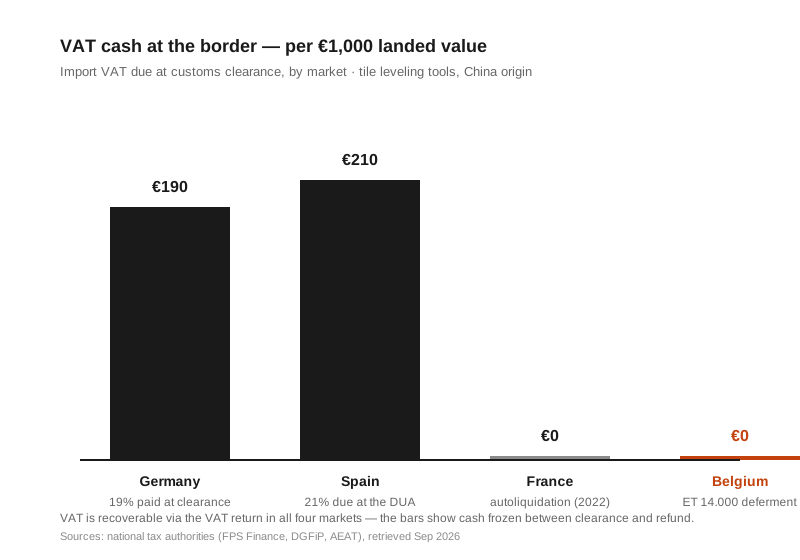
Bottom line: Belgium is a small market with outsized logistics: Antwerp-Bruges moves 12–13.5 million TEU a year behind only Rotterdam, with 300+ liner services — including direct sailings from Ningbo in 25–28 days. Duty is the standard EU 6.5% on TARIC 3926.90.97; the 21% import VAT disappears at the border with an ET 14.000 deferment license, declared and deducted on the same periodic return. A 500-bag LCL trial lands around €835–1,165. Local brands (Levelit, Dakota) set the reference shelf price; importers compete on margin and private label, not on fighting the brands head-on.
VAT is declared and deducted on the same periodic return. Antwerp runs 30–40 days from Ningbo; direct services make it in 25–28.
Antwerp-Bruges: Europe's No. 2 Port, 12M+ TEU, 300+ Liner Services
Antwerp-Bruges handles roughly 12–13.5 million TEU a year — second in Europe only to Rotterdam — and in Q1 2025 its container throughput even edged past Rotterdam's for the quarter. For a leveling-system importer the numbers that matter are connectivity and speed: 300+ liner services reaching 800 destinations, several of them direct loops from Ningbo making the run in 25–28 days, with the typical door-to-port range at 30–40 days. Deep-water berths take the largest vessels on the Asia–Europe trade, so your container rarely waits for a transshipment slot. Sources: port of Antwerp-Bruges figures; DTFU, Sino-Shipping transit data — retrieved Sep 2026
Clearance at Antwerp runs 1–2 days, and inland distribution is where Belgium quietly wins: Brussels, Ghent, Liège and Antwerp itself are all within an hour's drive, and Paris, Cologne and Amsterdam sit inside a one-day truck radius. For a wholesaler supplying more than one market, Belgium is the natural consolidated-stock location — one container, one customs declaration, three sales territories.
ET 14.000: The License That Cuts 21% Border VAT to €0
Belgium's standard import VAT is 21%, charged on the customs value plus duty. Without help, that is real money frozen at clearance — and reclaimed only weeks later through the VAT return. The fix is the ET 14.000 authorization (postponed accounting for import VAT), issued by the FPS Finance: with it, the 21% is simply declared and deducted on the same periodic return, so nothing is paid to customs at the border. The example that sells the license to any finance director: a business importing €500,000 of goods a month would otherwise pre-finance about €105,000 in VAT — indefinitely rotating, but always tied up. Source: FPS Finance — Authorisation ET14000, finance.belgium.be, retrieved Sep 2026
Eligibility is practical, not bureaucratic: you must file periodic Belgian VAT returns and be a regular importer, and the application goes through MyMinfin tied to your Belgian VAT and EORI numbers. Most customs brokers run this as a standard work item alongside the first clearance. New to importing? Your first container can still clear under normal VAT payment, with the license following once the import record exists.
The EU basics apply as everywhere: 6.5% duty on TARIC 3926.90.97 for China-origin goods, EORI before the first shipment, CE marking on product and packaging — and a €150 FOB duty de minimis that makes 5–10 bag sample orders duty-free.
Local Brands Set the Shelf — Import Pricing Wins the Margin
Belgium's shelf is well defended: Levelit, a Belgian specialist brand trusted across Belgium and France, and Dakota's leveling range sit alongside the international names in professional dealers. That is not a reason to stay out — it is the margin map. Brand-name lines anchor the reference price; the merchant's own imported line, specified to the same clip dimensions and wedge compatibility, captures the price-sensitive contractor without cannibalizing the premium shelf.
What makes the import line credible with Belgian pros: identical sizing (1.0–3.0mm clips covering rectified and standard joints), reusable PE wedges rated 100+ cycles, and documentation they can file — CE, RoHS, and our TÜV Rheinland factory certification with its annual audit. A stockable reusable tile leveler line also gives merchants a display-friendly alternative to bag-in-box consumables. Private label makes it theirs: Pantone-matched packaging, Dutch/French bilingual labeling, MOQ 500 bags per SKU, 15–25 day production.
A 500-Bag Trial to Antwerp: €835–1,165 Landed
Start where Belgian merchants start: the consumable core. A first order of 300 bags of tile leveling clips (200×1.5mm + 100×2.0mm), 150 bags of tile leveling wedges and 50 bags of Spin Doctor fits eight cartons and an LCL slot.
⚖️ Guide prices are FOB Ningbo at MOQ and subject to raw material cost fluctuations — contact us for current pricing.
| Cost component | Amount | Basis |
|---|---|---|
| FOB Ningbo (500 bags) | ≈ $444 | clips $0.70–0.85/bag · wedges $0.80–1.00/bag · Spin Doctor $1.45–1.60/bag |
| LCL freight to Antwerp | $300–500 | 8 cartons, China→Belgium LCL rates |
| Import duty | ≈ $48–61 | 6.5% on CIF (TARIC 3926.90.97) |
| Import VAT 21% | ≈ €160–205 (deferred, ET 14.000) | declared + deducted on return — net cash €0 |
Landed total: roughly €835–1,165 with duty and freight in, of which about €160–205 of VAT never leaves the account under ET 14.000. At 35–55% distributor markup the trial generates €290–630 gross margin — and, priced against the branded shelf, typically 3–5 reorder conversations within the first quarter. Source: ZEBRA TOOLS landed-cost model — EU TARIC 6.5% duty on CIF + 21% Belgian VAT deferred, LCL China→Belgium rates. Sep 2026.
Re-Distribution: One Container, Three Markets
The Belgian play that scales is re-distribution. Import the container into Antwerp under your Belgian entity — ET 14.000 keeps the border VAT at zero — then serve Belgium directly and push volume into northern France and western Germany as intra-EU B2B supplies, where the reverse-charge mechanism again means no VAT cash moves at invoice. T-shaped spacers for large-format work (T-shaped tile spacers) and horseshoe shims round out the range once the clips-and-wedges core is reordering on its own. Wholesale per-line pricing for the full calculation sits on our tile leveling system wholesale supplier page.
For Belgian merchants without import infrastructure, the same logic works one step removed: an Antwerp-based consolidator or your customs broker can act as importer of record initially, while the merchant builds the ET 14.000 and EORI filings in parallel. Either way the market structure favors the importer — Belgium's whole trading history is built on being the point where Asia's containers become Europe's shelf stock.
Frequently Asked Questions
What duty and VAT apply to tile leveling systems imported into Belgium?
Duty is the EU-wide 6.5% MFN rate on TARIC 3926.90.97 for China-origin goods, calculated on CIF value. Import VAT is 21%, but with an ET 14.000 deferment authorization it is declared and deducted on the same periodic VAT return — nothing is paid at the border.
What is the Belgian ET 14.000 and who qualifies?
The ET 14.000 is Belgium's postponed-accounting authorization for import VAT, issued by FPS Finance. You qualify by filing periodic Belgian VAT returns and being a regular importer; the application is filed via MyMinfin against your Belgian VAT and EORI numbers. It eliminates pre-financing 21% VAT at customs entirely.
How long does shipping from Ningbo to Antwerp take?
Typical port-to-port transit is 30–40 days; direct services from Ningbo make Antwerp in 25–28 days, and Cape of Good Hope reroutings can add 10–14 days when in effect. Clearance at Antwerp adds 1–2 days, with next-day trucking across Belgium and one-day road access to Paris, Cologne or Amsterdam.
Can Belgian importers compete with established leveling brands like Levelit?
Yes — by positioning, not head-on pricing. Brands anchor the reference shelf price; an importer's private-label line with identical clip sizing, reusable 100+ cycle wedges and full CE/TÜV documentation captures the price-sensitive contractor segment. MOQ is 500 bags per SKU with 15–25 day OEM production lead time.