
Tile Substrate Flatness Requirements in Plain Terms
Bottom line: the slab under thin-set tile must hold 1/4 in over a 10 ft span and 1/16 in over any 1 ft for standard tile; large-format tightens the span figure to 1/8 in. Clips and wedges manage the joint — only substrate prep manages the plane.
Flatness is not levelness, and the standards treat them separately. Level compares the floor to gravity; a drained shower pan is deliberately unlevel. Flat compares the floor to itself — whether the surface stays in one plane. Tile and its adhesive care about flat, because a tile is rigid: set a 24 in porcelain panel across a 1/4 in hollow and either the tile bridges it with a void underneath, or it rocks and lands out-of-flat with the field. Thin-set can fill gaps, but it cannot be expected to re-sculpt a slab — that is what patching compounds and self-leveling underlayment are for.
For importers and distributors the clause matters commercially: a floor that fails flatness produces the same symptoms as bad hardware — hollow spots, lippage, cracks — and the first casualty in the argument is usually the product in the box. Writing the flatness prerequisite into your paperwork moves the fault line to where it belongs.
The Three Numbers: 1/4 in, 1/16 in and 1/8 in
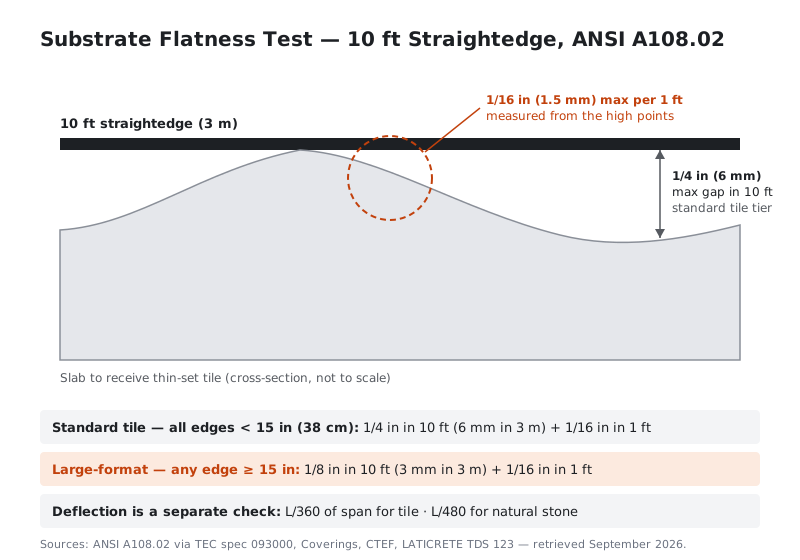
ANSI A108.02, the same workmanship standard that sets lippage limits, sets substrate flatness in two tiers plus a local check:
| Check | Standard tile (all edges < 15 in) | Large-format (any edge ≥ 15 in) |
|---|---|---|
| Span flatness, 10 ft | 1/4 in (6 mm) | 1/8 in (3 mm) |
| Local check, per 1 ft | 1/16 in (1.5 mm) from the high points — both tiers | |
| Deflection (separate, structural) | L/360 of span for tile; L/480 or stiffer for natural stone | |
Source: ANSI A108.02 as quoted in TEC Specialty's Section 093000 tile-setting specification (2025); large-format tier per Coverings and the Ceramic Tile Education Foundation; deflection per TCNA FAQ and LATICRETE TDS 123 — retrieved September 9, 2026.
Why Does 15 Inches Halve the Tolerance?
The large-format tier exists because of arithmetic, not aesthetics: a bigger tile spans more substrate with fewer joints. On a field of 4 in tiles, a slab wave spreads its deviation across many joints and each absorbs a fraction. On a 24×48 panel the same wave meets a single rigid body, and whatever the substrate does, the tile repeats — every millimeter of slab error becomes a candidate for voids, edge rocking and lippage beyond the ANSI tolerance limits. Halving the span tolerance is how the standard keeps the finished surface inside the same workmanship envelope.
Bedding does the rest: with less joint room to correct, the ANSI A108.5 mortar coverage requirements (80% dry, 95% wet, full edge support) and back-buttering carry the contact load on large formats. Substrate, coverage and leveling hardware are three legs; drop the flatness leg and the other two cannot hold the plane.
Flatness vs Deflection: Different Failures, Different Fixes
The two checks get confused because both end in a wavy floor, but they fail differently:
- Flatness is a surface property. Fix it where it is wrong: grind or planer humps, fill dips with patch compound, and when the field is broadly out of tolerance, pour self-leveling underlayment. Cost scales with how late you find the problem — which is the argument for testing before day one, not after the grout.
- Deflection is structural. A framed floor must not deflect more than L/360 of its span under load for tile, or L/480 for natural stone (TCNA; LATICRETE TDS 123). No surface product fixes a bouncy joist bay; blocking, better joist spacing or a suited assembly does. Deflection cracks grout lines in straight runs — a signature distinct from the hollow-sound and edge-rock symptoms of poor flatness.
How to Test a Slab Before It Eats Your Margin
The field method costs one tool and twenty minutes:
- Slide a 10 ft straightedge (or laser line) across the slab in both directions and diagonals, following the tile layout so the check mirrors where joints will fall.
- Measure the gaps under the edge with feeler or gap gauges at the worst points — the span figure gets 1/4 in (standard) or 1/8 in (large-format); any 1 ft stretch between high points gets 1/16 in.
- Mark and classify — carpenter-pencil the humps, distinguish broad waves (span problem) from sharp local bumps (1 ft problem), and photograph the marked slab for the handover file.
- Repair by class: grind humps, patch dips, self-level only when the marks run everywhere. Re-check after repair — the second pass takes five minutes.
Distributors shipping into contractor markets: this list, printed as a pre-install checklist in the carton, is the cheapest claim-prevention document you will ever ship — the same role the coverage clause plays in mortar disputes. And when the slab passes, tile leveling clips hold the joints to the standard while the mortar cures; if you are assembling both halves of that system for resale, our tile leveling system wholesale supplier page lists the range and MOQs.
What is the flatness requirement for a tile substrate?
Per ANSI A108.02: for standard tile (all edges under 15 in / 38 cm), the substrate must be flat within 1/4 in in 10 ft (6 mm in 3 m), with no more than 1/16 in (1.5 mm) of variation over any 1 ft measured from the high points. For large-format tile — any edge 15 in or longer — the 10 ft figure tightens to 1/8 in (3 mm).
How flat does the floor need to be for large-format tile?
1/8 in in 10 ft (3 mm in 3 m), half the standard-tile allowance, plus the same 1/16 in per 1 ft local check. The tolerance tightens because a large rigid panel spans more substrate with fewer joints, so every slab error transfers into the finished surface as voids, rocking edges or lippage.
What is the difference between flatness and levelness in tiling?
Levelness compares the surface to gravity; flatness compares the surface to itself — whether it stays in one plane. Tile requires flatness, not levelness: a shower pan is intentionally unlevel to drain, yet must still be flat enough for the tile to bond across it.
Can you tile over an out-of-flat floor?
Not beyond the tolerance: thin-set fills gaps but is not expected to re-sculpt a slab. Floors outside 1/4 in in 10 ft (1/8 in for large-format) are corrected first — grind or plane humps, fill dips with patch compound, or pour self-leveling underlayment when deviation is broad. Leveling clips then hold the joints during cure; they do not correct substrate waves.
Send us the tile formats your customers install — we will match the leveling hardware and the pre-install checklist that goes in the carton.
Ask Us About Your Market →