
Warpage and Lippage: Two Different Defects
The two words get used interchangeably in claim emails, and that is where the money leaks. They describe different geometry, happen at different stages and belong to different parties:
Curvature within one tile: the centre crowns, an edge lifts, a corner dips. Caused by differential shrinkage as the body fires. It exists before the tile leaves the factory, it is measurable on a flat table, and it is a product property.
Height difference between two adjoining tiles after setting. Created by the mortar bed, the substrate and the tile together, while the adhesive cures. It is measurable at the joint with a straightedge, and it is an installation outcome.
One tile on a flat table shows warpage. Two tiles side by side show lippage. Everything else in this article is what happens where the two meet.
What the Standards Allow: 0.5% Warp, 0.8mm Lippage
The product standard and the workmanship standard each draw their own line:
- ANSI A137.1 (product): maximum edge curvature and corner warpage of ±0.5% of the nominal dimension, measured per ASTM C485 — with ISO 10545-2 specifying the international method for surface flatness. On a 600 mm tile, 0.5% is a 3 mm crown that can ship fully compliant.
- ANSI A108.02 (workmanship): allowable lippage of 1/32 in (0.8mm) plus inherent tile warpage on grout joints from 1/16 in to under 1/4 in. The standard does not ask the installer to absorb the tile's curvature — it adds it on top of the allowance.
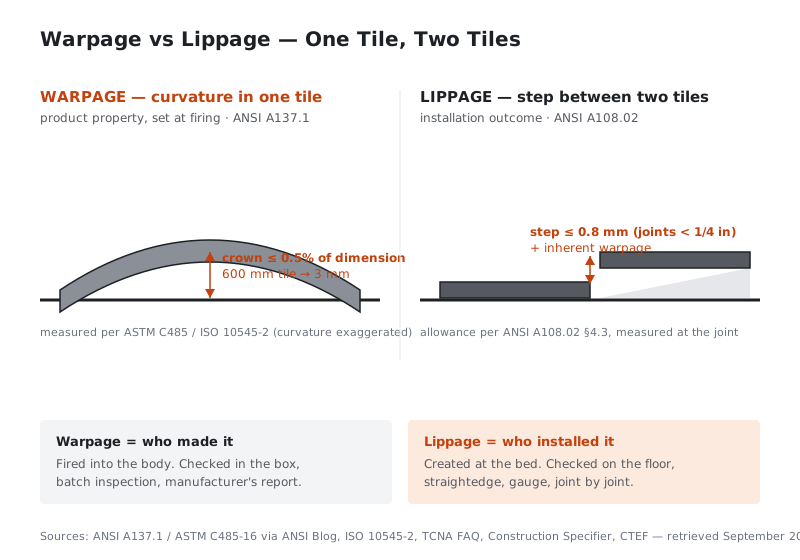
Read the two lines together and the chain becomes explicit: a compliant tile can consume most of a compliant installation's allowance before the trowel touches the floor. That is not a loophole — it is why the same SKU sets flat on 5 mm joints and reads sharp on 2 mm rectified joints, and why the ANSI lippage tolerance limits can only be quoted together with the tile's warp class.
Why Large-Format Makes Warpage Worse
Percentage limits scale with dimension, and so does the consequence: 0.5% of a 600 mm tile is 3 mm; 0.5% of a 1,200 mm slab is 6 mm — ten times the 0.8mm joint allowance. Bodies shrink as they fire, and the longer the edge, the more shrinkage differentiates between face and body, which is why big panels crown, rock and telegraph their curvature into the finished plane more than any field tile.
The established mitigations are pattern ones: keep running-bond offsets at 33% or less, size joints generously, and spec tighter warp classes for large formats — the territory covered in our rectified tile lippage guide. Hardware then does what it can: tile leveling clips pull adjoining edges into the same plane while the bed cures, but no clip unbends a fired body — a crowned tile held flat at its edges still crowns in the middle.
The Five-Tile Stack Test: Isolate Warp in Under a Minute
When a floor dispute lands, this is the fastest fault-isolator we know, and it needs nothing but the disputed boxes:
- Stack five tiles from the same box, face to face. A visible rocker or fan means curvature is in the product — measure it against the 0.5% line before the argument moves to the installer.
- Stack tiles from a different box. One bad box is a batch question; bad stacks across boxes are a production question — and the difference decides whether the claim is a carton credit or a container conversation.
- Compare with the floor. Flat stacks but a stepped floor points to the bed or the substrate, not the product — check the plane the tile landed on with our tile substrate flatness requirements tier table, and the mortar contact underneath it.
Photograph the stacks next to a straightedge on the disputed floor and attach both to the file. Between them, the two photos answer the only question a claim adjuster asks: whose standard did this floor miss — the product's or the installation's?
Writing Warpage Into Purchase Specs
Most RFQs fix on water absorption, format and price, and leave warpage unspecified — which means the buyer inherits whatever the production run baked in. One line closes it:
Warpage to comply with ANSI A137.1 (±0.5% of nominal dimension, ASTM C485 method; ISO 10545-2 for EN markets), verified by batch inspection report per production lot. Large-format items (>15 in) to be supplied with declared warp class compatible with the intended joint width and ≤33% offset installation pattern.
Buyers who put that line in the RFQ get a second document out of the factory — the batch warp report — and that report is what makes the five-tile stack test enforceable after the container lands. Pair it with the joint-width and coverage clauses from our earlier guides and the spec sheet covers all three layers: plane, bed and body. If you are assembling the full package — hardware, spec wording, container quantities — our tile leveling system wholesale supplier page has the range and MOQs.
What is tile warpage?
Curvature within a single tile — center crown, edge lift or bowing — caused by differential shrinkage of the body during firing. ANSI A137.1 caps it at ±0.5% of the tile's nominal dimension, measured per ASTM C485 (ISO 10545-2 internationally); a 600 mm tile at 0.5% may crown 3 mm and still ship compliant.
What is the difference between warpage and lippage?
Warpage is curvature within one tile — a product property set at the factory. Lippage is the elevation difference between two adjoining tiles after installation — an outcome of the mortar bed, substrate and tile combined. Warpage contributes to lippage, which is why ANSI A108.02 adds the tile's inherent warpage on top of the 0.8mm workmanship allowance.
What causes tile warpage?
Differential shrinkage during firing: variations in raw materials and kiln conditions make parts of the body contract at different rates, producing crown, edge lift or bow. The effect scales with dimension, so large-format and long-edge tiles show the most curvature for the same percentage limit.
Can tile leveling clips fix warpage?
Only partially. Clips pull adjoining edges into one plane while the adhesive cures, which removes the step at the joint — but a crowned body stays crowned between its edges, and no hardware unbends fired tile. For high-warp stock the fixes are spec-side: tighter warp classes, wider joints, and running-bond offsets of 33% or less.
Send us your tile formats and joint widths — we will quote the leveling hardware and the spec lines that keep warp claims off your desk.
Ask for a Batch Warp Report →